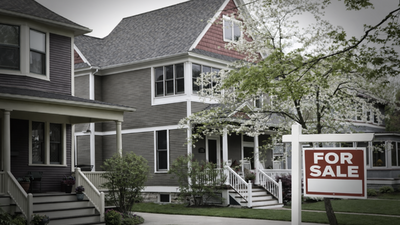
You paid off your mortgage, but the bills never stopped. Property taxes increased 27% nationally between 2019 and 2024. Illinois homeowners pay the highest rates at 1.92% to 2.0%, with median bills between $5,399 and $6,243 annually. Homeowners insurance is up 24% nationwide, hitting $9,462 per year in Florida. Your 40-year-old home needs $10,000 to $50,000 in major repairs as roofs, HVAC systems, and foundations hit end-of-life simultaneously. You're sitting on $400,000 in equity but can't access it without selling (costing $47,000 to $85,000 in transaction fees), getting a reverse mortgage (2% upfront premium plus fees), or taking a HELOC you might not be able to afford. And if you refinanced at 2.5% to 3.5% in 2020-2021, trading that rate for today's 6.5% to 8% rates makes downsizing a lateral move at best. These five forces weren't designed for fixed-income retirees. Here's how they work and why they're trapping millions.
Why "Paid Off" No Longer Means Secure
You made the last mortgage payment and expected financial relief. No more monthly payment to the bank. No more interest eating away at your budget. Just property taxes, insurance, and basic upkeep.
That's what your parents experienced. They paid off the house in their 50s and lived comfortably on Social Security and a modest pension. Their property taxes stayed manageable. Insurance was predictable. The house was 20 years old, not 40, so maintenance was minimal.
Your reality is different. Average non-mortgage housing costs run $21,400 per year nationally. In Illinois, it's $19,741. You're spending more per month now than some people pay in full mortgage payments. And the costs are rising 5% to 10% annually while Social Security adjusts by 2% to 3% if you're lucky.
This isn't personal failure. This is systemic breakdown. Five economic forces are working together to make "aging in place" unaffordable for millions of boomers. Here's what's actually happening.
Force 1: Property Taxes Rising Faster Than Fixed Incomes
The 27% Increase Nobody Planned For
Property taxes increased 27% nationally between 2019 and 2024. That's not 27% over 30 years. That's five years. And the trajectory isn't slowing down.
In Illinois, the effective property tax rate sits between 1.92% and 2.0%. That's the highest in the nation. The median bill ranges from $5,399 to $6,243 per year depending on your county. That translates to $450 to $520 per month for a house you own free and clear.
In Cook County, the median is closer to $6,000 to $6,500. In Will County, it's $5,800 to $6,200. Even in lower-cost counties, you're still looking at $4,000 to $5,000 annually.
The Reassessment Cycle Nobody Controls
Property tax bills aren't static. They rise with reassessments and levy increases. Reassessment cycles vary by county, but most operate on a three-year or four-year rotation. When your home gets reassessed and the value jumps 15% to 20%, your tax bill follows.
You have no control over this. The county assessor determines your home's value. The taxing districts (schools, parks, libraries, municipalities) set the levy. Your bill is the result of those two forces multiplying together.
And unlike a mortgage that eventually ends, property taxes never stop. They compound annually for as long as you own the home.
The Impact: People Are Being Taxed Out of Their Homes
Research shows that for every $100 annual increase in property taxes, there's a 0.73 percentage point increase in two-year mobility for homeowners over 50. That's an 8% jump from baseline mobility rates of around 9%.
A $500 property tax increase pushes mobility to nearly 13%. A $1,000 increase? You're looking at forced exits for a significant portion of the population.
20% of retirees say they struggle to pay their property taxes every year. One in five. And that number is rising as reassessment cycles catch up with post-pandemic home value increases.
Force 2: Homeowners Insurance Doubling in Climate-Affected States
The 24% National Increase
Homeowners insurance is up 24% nationwide between 2021 and 2024. The national average right now is $3,303 per year. For most of the country, that's a manageable increase spread over three years. Painful, but not catastrophic.
But averages mask the crisis unfolding in climate-affected states.
When Insurance Becomes a Luxury Item
In Florida, homeowners insurance averages $9,462 per year. That's nearly three times the national average. Some Florida homeowners report annual premiums above $12,000 for homes in hurricane-exposed areas.
In parts of California near wildfire zones, some homes are literally uninsurable. Insurance carriers are pulling out of high-risk markets entirely. You can't get a policy at any price.
The same pattern is emerging in coastal Louisiana, parts of Texas near the Gulf, and increasingly in the inland West where wildfire risk is accelerating.
Why Insurance Is Different From Property Taxes
Some states allow you to defer property taxes. Illinois has programs where you can push payments down the road and settle when you sell or pass. Insurance doesn't work that way.
If you don't have insurance, you can't get a reverse mortgage. Lenders require proof of insurance as a condition of the loan. You can't get a home equity line of credit for the same reason. And if you try to sell, most buyers need financing, and their lenders require the home to be insurable.
No insurance means your home becomes unsellable. The asset you've spent 30 years paying off becomes worthless because the insurance market decided your climate risk is too high.
The Quiet Displacement Crisis
We're already seeing forced exits from climate-affected states. People who've lived in Florida for 30 years are trying to sell because they can't afford or can't obtain insurance anymore.
This is displacement by a different mechanism than foreclosure, but the outcome is the same. People losing homes they own outright because the carrying costs became impossible.
Force 3: The 40-Year-Old House Time Bomb
When Everything Breaks at Once
The median age of homes in the U.S. is between 40 and 43 years old. Nearly half of all homes were built before 1980. That matters because major systems have lifespans, and when your house hits 40 years, they're all approaching end-of-life simultaneously.
Maintenance spending for homes built before 1980 spiked 76% in 2023 alone. That's not inflation. That's roofs, HVAC systems, water heaters, foundations, plumbing, and electrical all failing within a narrow window.
The Costs Add Up Fast
Here's what you're looking at when major systems fail:
- Roof replacement: $5,900 to $12,900 (average $8,400). Lifespan: 20 to 30 years depending on material.
- HVAC system: $5,000 to $8,300 (average $6,650). Lifespan: 15 to 20 years.
- Water heater: $800 to $1,500 for standard tank models. Lifespan: 8 to 12 years.
- Foundation repair: $2,196 to $7,921 (average $5,056). Can reach $50,000 for severe structural damage.
- Septic system replacement: Up to $9,500 in rural and suburban areas. Lifespan: 20 to 30 years.
One major repair wipes out an emergency fund. Two repairs back-to-back force impossible decisions. And if you're carrying non-mortgage debt (median $11,349 for retirement-age adults), you have even less cushion to absorb these shocks.
The Deferred Maintenance Doom Loop
You can't afford the $15,000 roof, so you patch it. The leak gets worse. Now it's not just a roof. It's water damage inside the ceiling and walls. Then it's mold remediation. What started as a $15,000 problem becomes a $30,000 crisis because you couldn't afford to fix it the first time.
Deferred maintenance doesn't save money. It compounds the problem and increases the eventual cost.
The Market Knows When You're Desperate
Emergency sales due to deferred maintenance fetch about a 15% discount compared to planned sales. Buyers see the peeling paint, the sagging roof, the HVAC system that's one summer away from failure. They price that risk into their offers.
And here's another revealing stat. New owners of older homes spend about $3,900 per year on maintenance. Longtime owners spend $1,500 per year. That gap tells you everything. Longtime owners aren't spending less because their homes need less. They're spending less because they can't afford it. They're deferring, and when they finally sell, that deferred maintenance becomes a discount.
Force 4: The Equity Paradox
House Rich, Cash Poor
73% of homeowners say they feel "house rich, cash poor." Retirees in this country hold $13.95 trillion in home equity. But median liquid savings is only $186,000.
For lower-income retirees with household income between $50,000 and $99,000, the numbers are even tighter. Median liquid savings: $120,000. Median home equity: $140,000. You have more wealth locked in your house than you have in accessible savings.
The problem is simple: you can't pay bills with home equity unless you convert it to cash. And every conversion method comes with significant costs or risks.
Why You Can't Just "Tap Your Equity"
Selling costs $47,000 to $85,000 or more. That includes real estate commissions (typically 6%, or $24,000 on a $400,000 home), closing costs (2% to 5%, or $8,000 to $20,000), repairs and staging to get the house market-ready ($5,000 to $20,000), and moving expenses ($2,000 to $10,000). Your "$150,000 profit" from downsizing just became $65,000 to $103,000.
Reverse mortgages have high upfront costs. There's a 2% mortgage insurance premium, plus origination fees that can reach $6,000 or more. And adoption remains incredibly low. There were only 30,898 reverse mortgage originations among borrowers 62 and older, compared to 609,000 payment-required loans in the same age group. Research shows that 17% to 27% of borrowers would qualify, meaning the potential market is 9 to 14 times larger than actual adoption. Stigma and perceived complexity prevent optimal tool choice.
HELOCs require monthly payments. Many retirees on fixed incomes can't afford to service the debt, especially with variable interest rates that can spike unexpectedly. If you can't make the payments, you risk foreclosure.
When Housing Costs Drive Retirement Volatility
Housing spending drives retirement volatility five times more than healthcare spending. Everyone worries about medical bills in retirement, and they should. But housing costs create five times more unpredictable swings in retiree budgets.
Retirees in 41 states are projected to outlive their savings. The average shortfall is $115,000. In high-cost states like New York, California, and Hawaii, the shortfall reaches $337,000 to $448,000. Housing costs are the primary driver of that gap.
Force 5: The Mortgage Rate Lock-In Prison
How the Fed Created Winners and Losers
Between 2021 and 2022, mortgage borrower mobility dropped sharply. 44% of that drop was due to rate lock-in. Homeowners who refinanced during the 2020 to 2021 period locked in rates between 2% and 3.5%. Those were historically low rates, and millions of people took advantage.
Now mortgage rates sit between 6.5% and 8%. If you want to downsize from a $400,000 home to a $250,000 condo, you'd think you're cutting costs. But if you have to finance that smaller home at 6.5% instead of the 3% you're currently paying, your monthly payment might stay the same or even increase.
You're not downsizing your costs. You're trading equity for a higher interest rate.
The Generational Debt Shift
Half of early boomer retirees are still making mortgage payments. The median debt is $108,500. That's double what the previous generation carried into retirement, even after adjusting for inflation.
For homeowners 75 and older, median mortgage debt sits at $106,800, up 61% compared to 1998 in inflation-adjusted terms. About 10 million homeowners 65 and older carry mortgage debt.
Your parents' generation retired with the house paid off. Your generation is retiring with six-figure mortgage debt. And rate lock-in means even people who want to downsize can't do it without making the problem worse.
The Silver Tsunami That Never Came
In 2023, Wall Street analyst Meredith Whitney predicted 30 million boomer-owned homes would flood the market in 2024 and 2025. The media ran with it. Buyers waited for the crash. Sellers panicked.
It didn't happen. Freddie Mac called it a "tide, not a tsunami." Boomers regained the largest share of both buyers and sellers in 2025, but volume remained nowhere near tsunami levels. Inventory stayed frozen.
Rate lock-in is the primary reason. Empty-nest boomers hold 28% of three-bedroom-plus homes, while millennials with kids hold only 14%. The mismatch exists, but boomers aren't moving because the financial math doesn't work.
What These Five Forces Mean for Your Next Decade
The System Wasn't Designed for Retirees
The property tax system was designed for working-age homeowners with rising wages. It was not designed for retirees on fixed incomes. Insurance pricing was built before climate risk accelerated at this pace. Homes were constructed 40 years ago and are hitting end-of-life now. Equity tools are expensive or stigmatized. And the Federal Reserve created a rate environment that locked people in place.
Five forces. Working together. Making "aging in place" unaffordable for millions.
The Math That Determines Your Next Move
Calculate your total annual housing costs: property taxes, insurance, utilities, maintenance, and repairs. If that total exceeds 30% of your gross annual income, you've crossed into the "cost-burdened" threshold that economists use to define financial distress. One in four retirees already exceeds this threshold.
If you're approaching that threshold or already past it, you have decisions to make. Property tax relief programs in states like Illinois can buy you time. Break-even analysis can tell you whether downsizing makes financial sense. Understanding the tool differences between selling, HELOCs, and reverse mortgages helps you match the solution to your specific crisis.
But the first step is understanding that this isn't your fault. The system wasn't built for retirement reality. The forces are structural, not personal.
- Property taxes increased 27% nationally between 2019 and 2024; Illinois rate is 1.92% to 2.0% (highest in nation) with median bills $5,399 to $6,243 annually
- Homeowners insurance up 24% nationwide (2021-2024); Florida averages $9,462/year vs. national average of $3,303
- Maintenance spending for pre-1980 homes spiked 76% in 2023; major repairs cost $10,000 to $50,000+ as systems hit end-of-life
- 73% of homeowners feel house rich, cash poor; accessing equity requires selling ($47K-$85K+ in costs), reverse mortgage (2% premium + fees), or HELOC (monthly payments)
- 44% of mobility drop (2021-2022) due to rate lock-in; trading 3% mortgage for 6.5% rate doubles monthly payments
- Average non-mortgage housing costs: $21,400/year nationally, $19,741 in Illinois, rising faster than Social Security adjustments
- For every $100 annual property tax increase, two-year mobility for 50+ homeowners increases 0.73 percentage points (8% jump from baseline)
Related Reading
This article focuses on the five economic forces making paid-off homes unaffordable. For related topics:
- Overview: Read the comprehensive guide on why paid-off homes have become retirement threats for the full system view including market dynamics and wealth transfer shifts
- Homeowner Reality: Understand what it feels like when these five forces push you into crisis, including the three common pathways and the identity crisis of letting go
- Smart Moves: Get the break-even calculator, tool comparison guide (HELOC vs. reverse mortgage vs. selling), timing strategies, and Illinois-specific property tax relief application process
- Market Briefings: Learn about the silver tsunami that didn't happen, the senior housing supply crisis (370K-560K units short by 2030), and regional exodus patterns
References
- Bankrate. "Average Non-Mortgage Housing Costs by State 2025."
- SmartAsset & AARP. "Illinois Property Tax Rates and Median Bills by County 2025."
- Investopedia. "Homeowners Insurance Costs by State 2025."
- American Hartford Gold & NextBestHome. "House Rich, Cash Poor: Survey of U.S. Homeowners 2024."
- Boldin. "Median Home Equity and Liquid Savings for Retirees by Income Bracket 2024."
- U.S. Census Bureau & NAHB. "Median Home Age and Maintenance Spending Trends 2023-2024."
- Forbes, SoFi, Yahoo Finance. "Major Home Repair and Replacement Costs 2025."
- Federal Reserve. "Mortgage Borrower Mobility and Rate Lock-In Effects 2021-2022."
- PMC/PubMed. "Property Tax Impact on Elderly Homeowner Mobility (Longitudinal Study 2010)."
- Boston College Center for Retirement Research. "Mortgage Debt Among Early Boomer Retirees 2022."
- Urban Institute. "Mortgage Debt Trends for Homeowners 75+ (1998-2022)."
- LendingTree & LiveNowFox. "Non-Mortgage Debt Among Retirement-Age Adults 2025."
- Oxford Academic. "Reverse Mortgage Originations and Adoption Rates (HECM Study 2018)."
- Experian, Bankrate, PNC. "Reverse Mortgage Costs and Fee Structure 2025."
- Savant Wealth & Investopedia. "Home Sale Transaction Costs 2025."
- NAR & Virginia Realtors. "Bedroom Distribution by Generation 2024-2025."
- Realtor.com & American Hartford Gold. "States Where Retirees Risk Outliving Savings 2025."
- PlanSponsor. "Housing vs. Healthcare Spending Volatility in Retirement 2023."
- Retirement Statistics. "Cost-Burdened Retirees and Property Tax Stress Indicators 2024-2025."