

Illinois has already confirmed 210 tornadoes in 2026, smashing the state's previous annual record of 142. And if it feels like the southwest suburbs have been getting an unusual share of the severe weather lately, you're not imagining that either. Two major storm events just 15 days apart produced confirmed tornadoes around Orland Park, Mokena, Tinley Park and surrounding communities, along with destructive straight-line winds through Frankfort and eastern Will County. At the same time, research shows tornado activity across the United States has been shifting east from parts of the traditional Great Plains toward the Midwest and Southeast.
210 tornadoes.
That's how many had already been confirmed in Illinois this year as of August 29.
For a little perspective, Illinois averages about 54 tornadoes in an entire year based on the state's 1991-2020 climate data.
And the previous Illinois record?
142.
We blew past that months ago.
Which brings up a question that probably would have sounded a little strange around here not that long ago:
Is Tornado Alley moving toward Illinois?
Quick Summary
- Illinois had 210 confirmed tornadoes in 2026 as of August 29.
- The previous Illinois annual record was 142 tornadoes in 2024.
- Texas holds the certified single-state annual record with 244 tornadoes in 2015.
- Illinois also had 243 preliminary tornado reports as of late August, but preliminary reports are not the same as final confirmed tornado counts.
- Seven tornadoes were confirmed in the NWS Chicago area on July 27.
- Another eight tornadoes were confirmed during the August 11 derecho.
- Recent research has documented a long-term shift in tornado activity away from parts of the Great Plains and toward the Midwest and Southeast.
Illinois Isn't Just Having a Busy Tornado Year
Calling 2026 "active" almost undersells what has happened.
The Illinois State Climatologist says the state averages about 54 tornadoes per year using the 1991-2020 climate period.
Illinois had already reached 108 tornadoes by May 1.
By July 1, the count had jumped to 173.
And as of August 29, the National Weather Service had confirmed 210 tornadoes across Illinois in 2026.
That absolutely crushes the previous state record of 142 set just two years ago in 2024.
It also puts Illinois surprisingly close to a record normally associated with a state much farther southwest.
Texas holds the certified record for the most tornadoes confirmed in a single state during one year: 244 in 2015.
At 210, Illinois was only 34 tornadoes away from tying it.
And Then It Started Feeling Very Local
Statewide tornado statistics are one thing.
Watching trees come down in your own neighborhood is something else.
For the southwest suburbs, this summer has been especially difficult to ignore because two major severe-weather events came through the area just 15 days apart.
July 27: Seven Tornadoes and Destructive Winds
On July 27, intense thunderstorms moved through northeastern Illinois and produced seven confirmed tornadoes within the National Weather Service Chicago forecast area.
One of those was an EF-0 tornado in Orland Park with estimated peak winds of 85 mph.
But tornadoes were only part of the problem.
The National Weather Service found that portions of southern Cook County and eastern Will County experienced straight-line winds estimated at 80 to 105 mph.
Tinley Park, Frankfort, Matteson, Monee, Crete and several surrounding communities were among the hardest-hit areas.
Trees came down. Homes and other structures were damaged. Power went out across portions of the region.
Then we barely had time to clean everything up.
August 11: Eight More Tornadoes
Just over two weeks later, another major storm system came through.
This one became a powerful derecho that produced widespread winds of 70 mph and higher across northeastern Illinois and northwest Indiana.
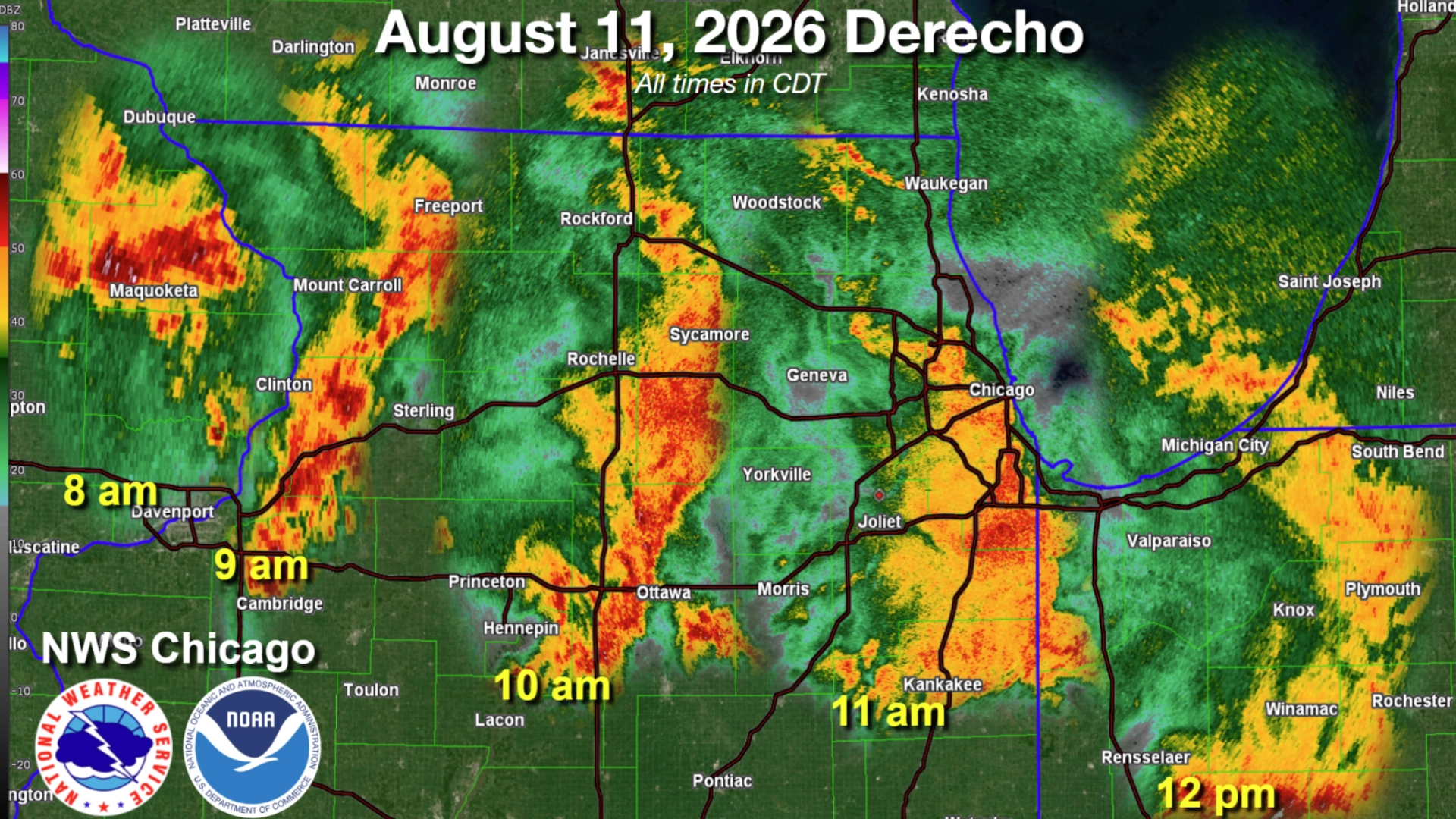
The August 11 derecho moved across northern Illinois and northwest Indiana during the morning hours. Source: NOAA / National Weather Service Chicago.
The National Weather Service eventually confirmed eight tornadoes from the event in its Chicago forecast area.
Several went directly through the communities we cover here.
- Mokena to Tinley Park: EF-1
- Orland Park to Hammond, Indiana: EF-1
- Monee into northwest Indiana: EF-2
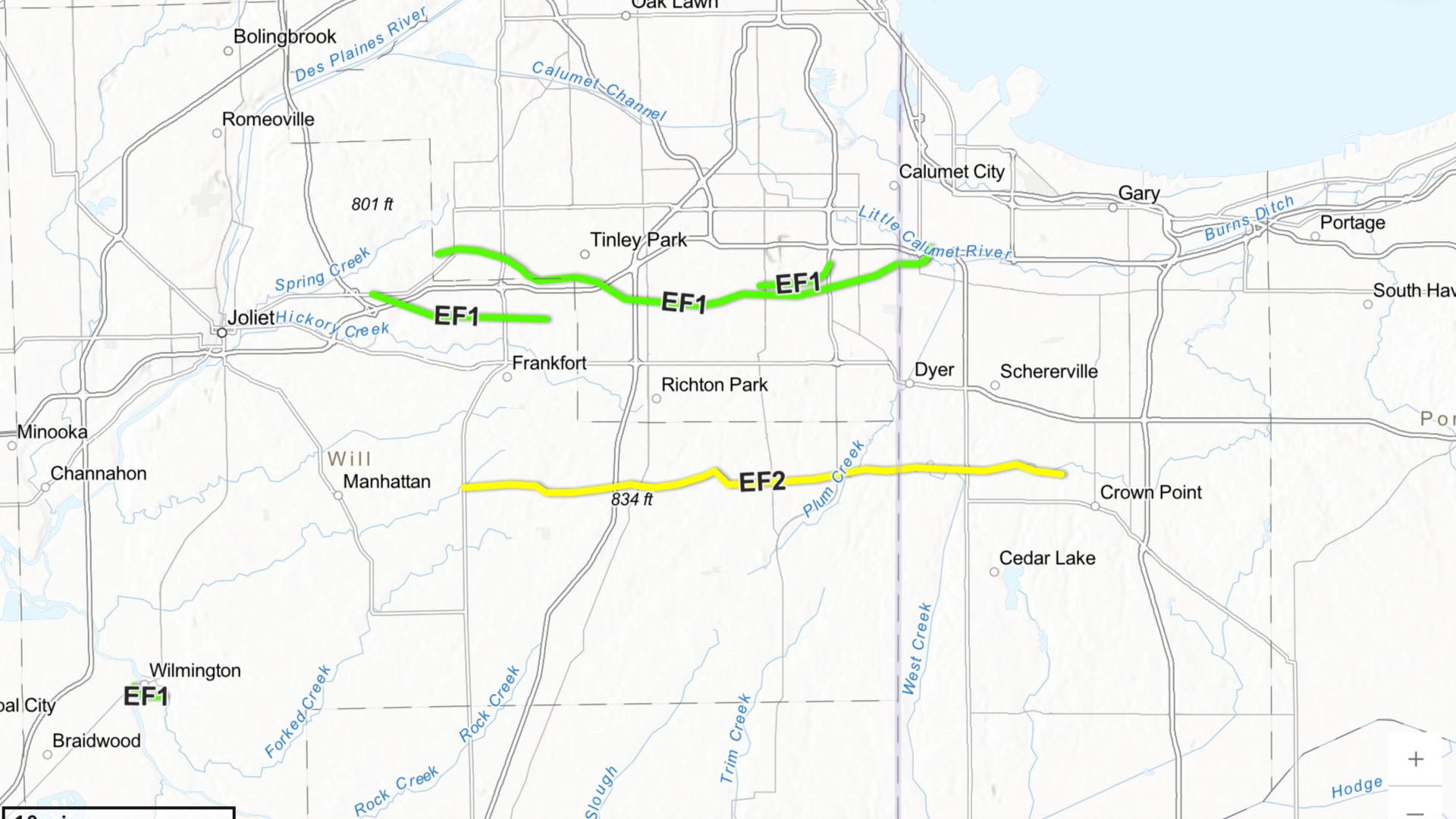
Confirmed tornado tracks from the August 11 derecho. Click this link to view the National Weather Service Chicago storm survey and interactive tornado tracks. Source: NOAA / National Weather Service Chicago.
The Orland Park tornado traveled more than 22 miles and moved through southern portions of Orland Park and Tinley Park before continuing east into Indiana.
The EF-2 that began south of Frankfort near Monee produced estimated peak winds around 115 mph before continuing toward northwest Indiana.
Frankfort itself recorded estimated thunderstorm wind gusts exceeding 75 mph during the derecho.
So if this summer has felt different around here, there are numbers behind that feeling.
So... Is Tornado Alley Actually Moving?
The short answer is:
There is evidence that U.S. tornado activity has been shifting east.
But there is a little more nuance than simply drawing a new Tornado Alley on a map.
"Tornado Alley" has never had an official government boundary. It's a popular term traditionally used for the part of the central Great Plains known for frequent tornado activity, particularly areas such as Texas, Oklahoma, Kansas and Nebraska.
But researchers have been noticing something different in the data.
A 2024 peer-reviewed study using decades of tornado records found that tornado activity has shifted away from portions of the Great Plains and toward the Midwest and Southeast United States.
The researchers looked specifically at stronger F/EF-1 and greater tornadoes to reduce the effect of better modern radar, storm spotting and reporting of very weak tornadoes.
When they compared 1951-1985 with 1986-2020, tornado activity decreased in the western portion of the country they studied while increasing in the eastern portion.
In other words, this isn't only a case of people owning more smartphones and noticing more tornadoes.
There appears to be a real geographic shift.
That Doesn't Mean Oklahoma Is Suddenly Safe
This is where headlines can get carried away.
Tornado Alley didn't pack up a moving truck and relocate to Illinois.
Texas, Oklahoma and Kansas can still experience devastating tornado outbreaks.
And one extraordinary year in Illinois doesn't prove that every future year will look anything like 2026.
Weather patterns change from year to year.
What the longer-term research suggests is that the geography of tornado risk isn't as simple as the old map many of us grew up seeing.
The Midwest deserves to be part of that conversation.
Why Has 2026 Been So Extreme?
There isn't one simple explanation for every tornado Illinois has seen this year.
Weather patterns repeatedly placed the Midwest in an environment where warm, humid air collided with strong winds and disturbances higher in the atmosphere.
That combination can provide both the instability thunderstorms need to grow and the wind shear that helps storms rotate.
During the spring, Illinois experienced unusually warm conditions while repeated storm systems crossed the region.
June alone produced at least 65 tornadoes in Illinois, according to the Illinois State Climatologist.
Then the severe-weather pattern continued into July and August.
It has essentially been one active stretch after another.
There's Another Reason Tornado Counts Are Higher Today
There's also something important to understand when comparing today's tornado totals with what happened 50 or 70 years ago.
We're much better at finding tornadoes now.
Modern Doppler radar, storm-spotter networks, smartphones, security cameras and damage surveys can identify weak tornadoes that might have passed almost unnoticed decades ago.
The Illinois State Climatologist has specifically warned that improvements in detecting weak tornadoes create an apparent upward trend in the historical record.
That's one reason researchers studying geographic changes often focus on stronger tornadoes, which were more likely to have been documented even decades ago.
So when somebody says tornadoes are increasing, the right question is:
Which tornadoes? Over what time period? And using what data?
2026 is still extraordinary either way.
The Part That Should Matter Around Here
I don't think the biggest takeaway is whether Illinois eventually catches Texas at 244 tornadoes.
That makes a great headline.
But there isn't a prize for winning.
The more important lesson is that severe weather is becoming increasingly difficult to treat as something that mostly happens somewhere else.
Within 15 days this summer, tornadoes and destructive winds affected Orland Park, Mokena, Tinley Park, Frankfort and communities immediately around us.
And some of those storms moved incredibly fast.
We May Need to Change How We Think About Tornado Season
Illinois tornado season traditionally peaks between April and June.
But tornadoes can happen here during every month of the year.
And the same research documenting the eastward geographic shift also found another change:
Tornado activity has been shifting away from the traditional warm season and toward the colder portion of the year.
That doesn't mean Labor Day suddenly becomes tornado season.
It does mean the old idea that you mostly worry about tornadoes during a few spring months isn't particularly useful anymore.
Illinois has had damaging tornadoes in winter before.
We've had them in summer.
And the state's deadliest historical events certainly aren't confined to one neat weather calendar.
Maybe "Tornado Alley" Was Always Too Simple
For decades, a lot of us pictured Tornado Alley as a strip through Oklahoma, Kansas and Texas.
Somewhere far enough away that tornadoes around Chicago felt unusual.
They aren't.
Illinois has always had tornadoes.
The Plainfield tornado in 1990 remains one of the most devastating weather disasters in Illinois history, and the 1967 Oak Lawn outbreak is another reminder that the Chicago region has never been immune.
What may be changing is where tornado activity is concentrating and how often the Midwest finds itself in the middle of the pattern.
And after the summer we've just had around the southwest suburbs, that's a shift worth paying attention to.
The Bottom Line
Illinois is having a tornado year unlike anything in its modern record.
As of August 29, 210 tornadoes had been confirmed, easily surpassing the previous state record of 142.
Whether Illinois eventually reaches Texas's all-time certified record of 244 remains to be seen.
But the larger story is already here.
Research shows tornado activity has been shifting east toward the Midwest and Southeast over several decades.
And this summer, the southwest suburbs got a very uncomfortable look at what that can mean.
Seven tornadoes during one late-July event.
Eight more during an August derecho.
Orland Park hit twice.
Tornado tracks through Mokena and Tinley Park.
Destructive winds through Frankfort and surrounding communities.
Maybe the question isn't whether Illinois is becoming the new Tornado Alley.
Maybe it's whether we need to stop thinking Tornado Alley was ever something that couldn't include us.
- Illinois had 210 confirmed tornadoes in 2026 as of August 29.
- The previous state record was 142 tornadoes in 2024.
- Texas holds the certified single-state annual record with 244 tornadoes in 2015.
- Seven tornadoes were confirmed during the July 27 severe-weather event in the NWS Chicago forecast area.
- Eight more tornadoes were confirmed during the August 11 derecho.
- Recent research shows tornado activity has shifted away from portions of the Great Plains toward the Midwest and Southeast.
- "Tornado Alley" has no official fixed boundary, and the change is more complicated than simply moving a line east on a map.
- Improved radar and reporting have increased detection of weak tornadoes, which is important when comparing modern totals with older records.
Frequently Asked Questions
How many tornadoes has Illinois had in 2026?
As of August 29, the National Weather Service had confirmed 210 tornadoes in Illinois during 2026. Preliminary Storm Prediction Center reports were higher, but preliminary reports are reviewed and can change before final tornado counts are certified.
What is the Illinois record for tornadoes in one year?
Illinois has already established a new state record in 2026. The previous annual record was 142 tornadoes in 2024.
What is the U.S. record for tornadoes in one state during one year?
Texas recorded 244 confirmed tornadoes in 2015, the highest certified annual total for a single state in the modern record.
Is Tornado Alley moving east?
Research has found a long-term geographic shift in tornado activity away from portions of the traditional Great Plains and toward the Midwest and Southeast. Tornado Alley does not have an official fixed boundary, so describing it as simply "moving" is an oversimplification, but the eastward shift in tornado activity is supported by research.
How many tornadoes hit the Chicago area on August 11, 2026?
The National Weather Service Chicago confirmed eight tornadoes from the August 11 derecho within its forecast area, including tornadoes affecting the Mokena-Tinley Park area, Orland Park, and communities extending into northwest Indiana.
Was there a tornado in Orland Park in 2026?
Yes. An EF-0 tornado affected Orland Park on July 27, and another EF-1 tornado began near the Orland Park area during the August 11 derecho before continuing east through Tinley Park and into northwest Indiana.
How many tornadoes does Illinois normally have?
Illinois averages about 54 tornadoes per year based on 1991-2020 climate data from the Illinois State Climatologist.
Does a higher tornado count mean all tornadoes are becoming stronger?
No. Modern radar, storm spotting and public reporting allow meteorologists to identify many weak tornadoes that may have gone undocumented decades ago. Researchers account for that problem by also studying stronger tornadoes and other measures such as tornado days and path length.
Sources & Weather Records
- National Weather Service Chicago — August 11, 2026 derecho and tornado damage surveys.
- National Weather Service Chicago — July 27, 2026 severe weather and tornado damage surveys.
- Illinois State Climatologist, Illinois State Water Survey — Illinois tornado climatology and 2026 severe-weather updates.
- NOAA Institutional Repository — "A Comprehensive Analysis of the Spatial and Seasonal Shifts in Tornado Activity in the United States," Journal of Applied Meteorology and Climatology, 2024.
- NOAA Storm Prediction Center — tornado climatology and preliminary storm-report data.
- NOAA national severe-weather archive — historical annual state tornado totals.
Weather Data Note: Tornado counts can change as National Weather Service offices complete damage surveys and the Storm Prediction Center reviews preliminary reports. Numbers in this article reflect information available through August 29, 2026.