
Disclosure: Some links on this page are affiliate links. If you choose to make a purchase through them, I may earn a small commission at no extra cost to you. As an Amazon Associate, I earn from qualifying purchases.
Most homes were not built with aging in mind. Standard doorways are too narrow for wheelchairs, bathtubs create fall risk every time someone steps over the edge, and hallways were designed for people who never have to think about how they move through a space. Retrofitting a home for aging in place means finding those friction points and fixing them before they become emergencies, some for a few hundred dollars, some for tens of thousands, depending on what the home needs and what the occupant requires.
This guide is for homeowners who want to stay in their home as they age, and for adult children helping a parent figure out what actually needs to change. It is also useful for anyone navigating a recent mobility change, a hip replacement, a fall, a new diagnosis, who needs to quickly understand what modifications are possible, what they cost in the real world, and where financial help exists.
Retrofitting is not an all-or-nothing project. Some of the most impactful changes cost under $100. Others require structural permits and licensed contractors. The goal here is to give you enough information to know where your situation falls and what to prioritize first.
Two Ways to Approach This
Before getting into specific modifications, it helps to understand how most families arrive at this conversation.
The first approach is reactive: something happens and you scramble. A fall in the bathroom. A surgery with a longer-than-expected recovery. A diagnosis that changes what the house needs to do. Reactive retrofitting is expensive and stressful because decisions get made under pressure, with limited time to research contractors, compare costs, or think through the equity implications.
The second approach is proactive: you assess the home now, make the easy changes while they are still easy, and build a plan for the bigger ones before they become urgent. Proactive retrofitting is almost always cheaper, less disruptive, and leads to better outcomes.
Most people who find this guide are somewhere in between. They are not in a crisis, but they can see one forming. That is actually the right time to act.
Start With the Bathroom, It Is the Highest-Risk Room in the House
The bathroom is where most household falls happen and where the consequences are most severe. It is also where the cheapest and most impactful modifications exist alongside some of the most expensive structural projects, sometimes in the same room.
For most households, the bathroom priority order looks like this: grab bars first, non-slip flooring second, toilet height third, and shower accessibility fourth. The first three can be addressed for under $1,000 in most cases without touching the structure. The fourth, converting a tub to a roll-in shower, is a structural project that starts around $9,000 and can reach $40,000 depending on what the subfloor and plumbing require.
One thing worth knowing upfront: suction-cup grab bars are not a safety device. Laboratory testing across multiple surface types shows a 100% failure rate over a 28-day period. Manufacturers label them non-weight-bearing for a reason. If a grab bar is going in the bathroom, it needs to be stud-anchored into solid wood blocking, anything else is a liability dressed up as a solution.
Bathroom Safety Starting Points
These are the items worth addressing before anything else in the bathroom:
- 2 Pack Shower Grab Bar (ADA Compliant) — 2-pack 18-inch stainless steel shower grab bars with anti-slip knurled grip, ADA-compliant and rated to support up to 500 lbs.
- HOMLAND raised toilet seat with padded seat, and handles, adjustable height and width, non-slip feet, and 400 lb capacity for safer sitting and standing.
- Machine-washable bathtub mat with suction cups, drainage holes, and a textured non-slip surface for added traction on smooth tub floors.
- Padded swivel shower chair with arms and back — adjustable height, and 400 lb capacity for safer, more supported bathing.
For the full structural breakdown, what a roll-in shower actually requires, why walk-in tubs demand a water heater upgrade, and how flooring material affects long-term fall risk, see the detailed guide: Major Structural Modifications for Aging in Place.
Entries, Doorways, and Getting Around the House
The second area most families address is access, getting in and out of the home, and moving through it once inside.
Standard residential doorways are 28–30 inches wide. A manual wheelchair requires a minimum 32-inch clear opening. A power chair or scooter needs more. Fixing that gap ranges from a $30 hardware swap to a $6,000 structural project, depending entirely on what the wall contains.
Before assuming a doorway needs to be widened, look at offset swing-clear hinges. These replace standard door hinges and physically pull the door out of the opening when it swings to 90 degrees, recovering up to 2 inches of clearance without any framing work. At around $30 per door, it is one of the most cost-effective modifications in this entire guide, and one of the most overlooked.
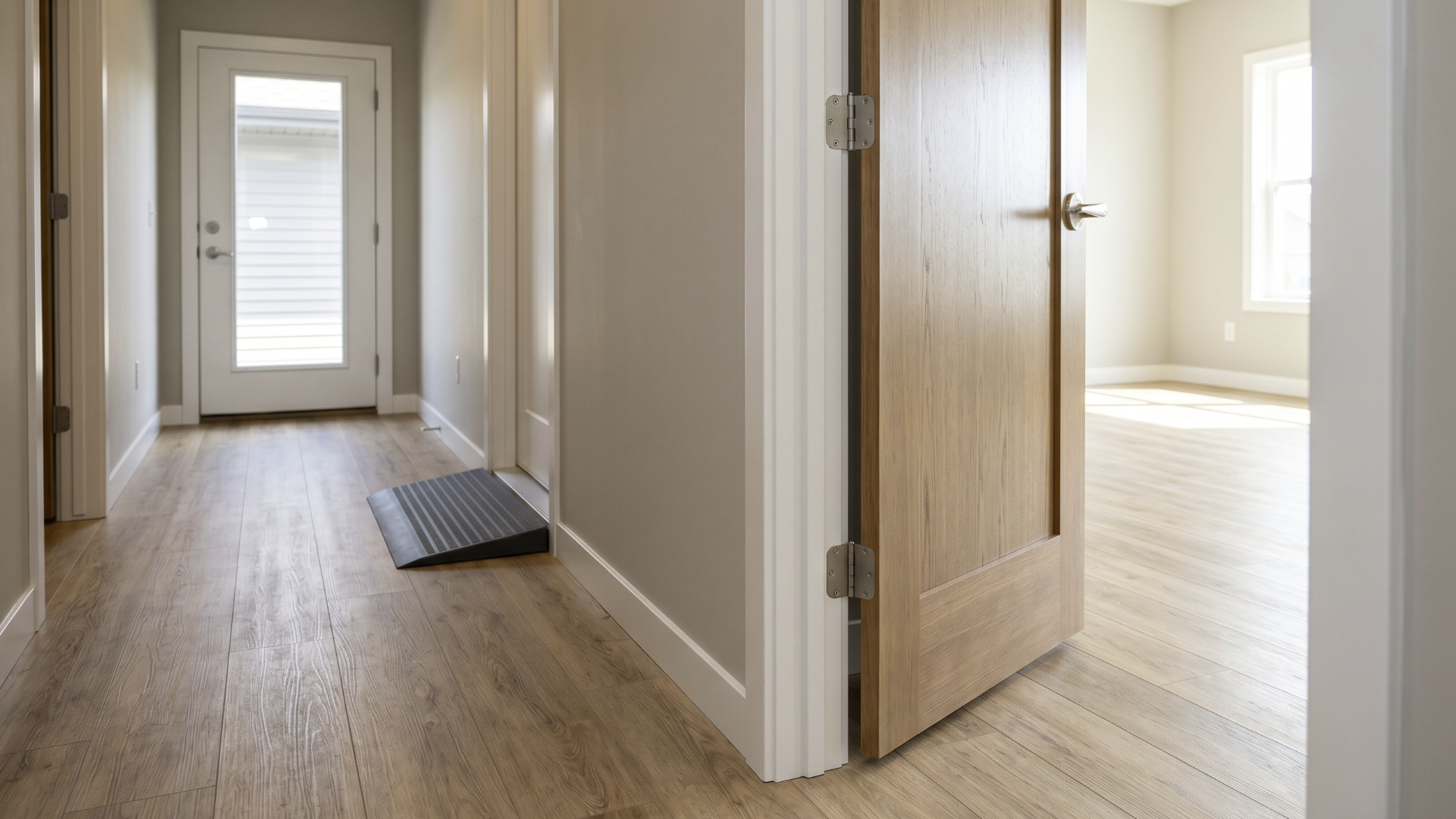
For exterior entries, a raised threshold or a single step is often the first barrier a mobility device encounters. Low-profile rubber threshold ramps handle rises up to 2 inches, support up to 1,500 lbs, and require zero installation. For larger rises, a full step or more, portable folding aluminum ramps are reusable, transportable, and significantly cheaper than any permanent solution.
Entry and Doorway Quick Wins
- 2-piece rubber curb ramp — heavy-duty 2.1-inch rise threshold ramps with slip-resistant surface, designed for wheelchairs, scooters, motorcycles, and vehicles. Rated up to 8,800 lbs and sized 38.6 inches long for smoother transitions over curbs and raised edges.
- ADA-compliant privacy lever door handle — satin chrome lever lockset for bathroom or office doors, designed for easier operation than round knobs and suitable for left- or right-hand doors.
- 6-foot folding aluminum wheelchair ramp — portable ramp with non-slip surface, support legs, and 800 lb capacity, designed for home steps, entryways, thresholds, and doorways.
Lighting and Electrical, The Most Underestimated Safety Upgrade
Lighting does not look like a mobility modification, but the data behind it is straightforward: a 60-year-old requires three to five times more ambient light than a 20-year-old to perform the same visual task. Most homes built before 2000 are significantly underlit for the 55+ demographic, and the consequences show up as falls, particularly at night.
The highest-risk moment is a nighttime bathroom trip. Turning on a bright overhead light at 2 a.m. destroys night adaptation and causes painful pupillary shock-glare. The solution is low-level motion-sensing pathway lighting along the floor plane, enough to see where you are going without a blinding response. Plug-in night light versions cost under $20 and are worth installing immediately. Hardwired baseboard systems are a longer-term upgrade.
Replacing standard toggle switches with illuminated rocker switches is another quick win that rarely gets mentioned. Rocker switches can be activated with a closed fist, elbow, or shoulder, no pinching required, and the internal LED makes them visible in a completely dark room. Individual units run under $12 and are a straightforward handyman swap.
Lighting Upgrades Worth Prioritizing
- Plug-in motion-sensor night lights — dimmable LED night lights with auto-on motion detection and warm light, useful for hallways, stairs, bathrooms, bedrooms, and other low-light areas./li>
- Motion-sensor light switch — automatic occupancy/vacancy wall switch that turns lights on and off based on room activity, with no neutral or ground wire required for installation on compatible single-pole circuits.
- Rechargeable under-cabinet LED lights — wireless motion-sensor task lights with adjustable brightness and color temperature, designed to improve visibility in kitchens, closets, stairs, and other dim work areas.
Kitchen and Living Area Modifications
Kitchen retrofits range from simple hardware swaps to full custom millwork. The single most cost-effective change is replacing cabinet knobs with ADA-compliant C-pull or bar-pull hardware. Standard knobs require a pincer grip that is painful or impossible for anyone with arthritis. C-pulls operate with a full hand or forearm, require less than 5 lbs of force, and run $2–$50 per pull depending on finish. For an average kitchen of 40–50 cabinet doors and drawers, the total material cost is manageable and the swap is a low-skill project.
Beyond hardware, the bigger kitchen modifications, lowering countertops, installing motorized pull-down upper shelving, and building accessible islands, are structural projects. A full accessible kitchen remodel in the Chicago suburban market runs $5,000 to $30,000+ depending on scope and whether plumbing is involved.
Kitchen Quick Wins
- Long reach grabber tool — 32-inch reacher with rotating jaw and ergonomic trigger, designed to help pick up items from floors, shelves, and tight spaces without bending or overreaching.
- Pull-out cabinet organizer shelf — adjustable slide-out shelf that brings items from the back of deep cabinets forward for easier access without excessive bending or reaching.
When the Project Requires a Contractor
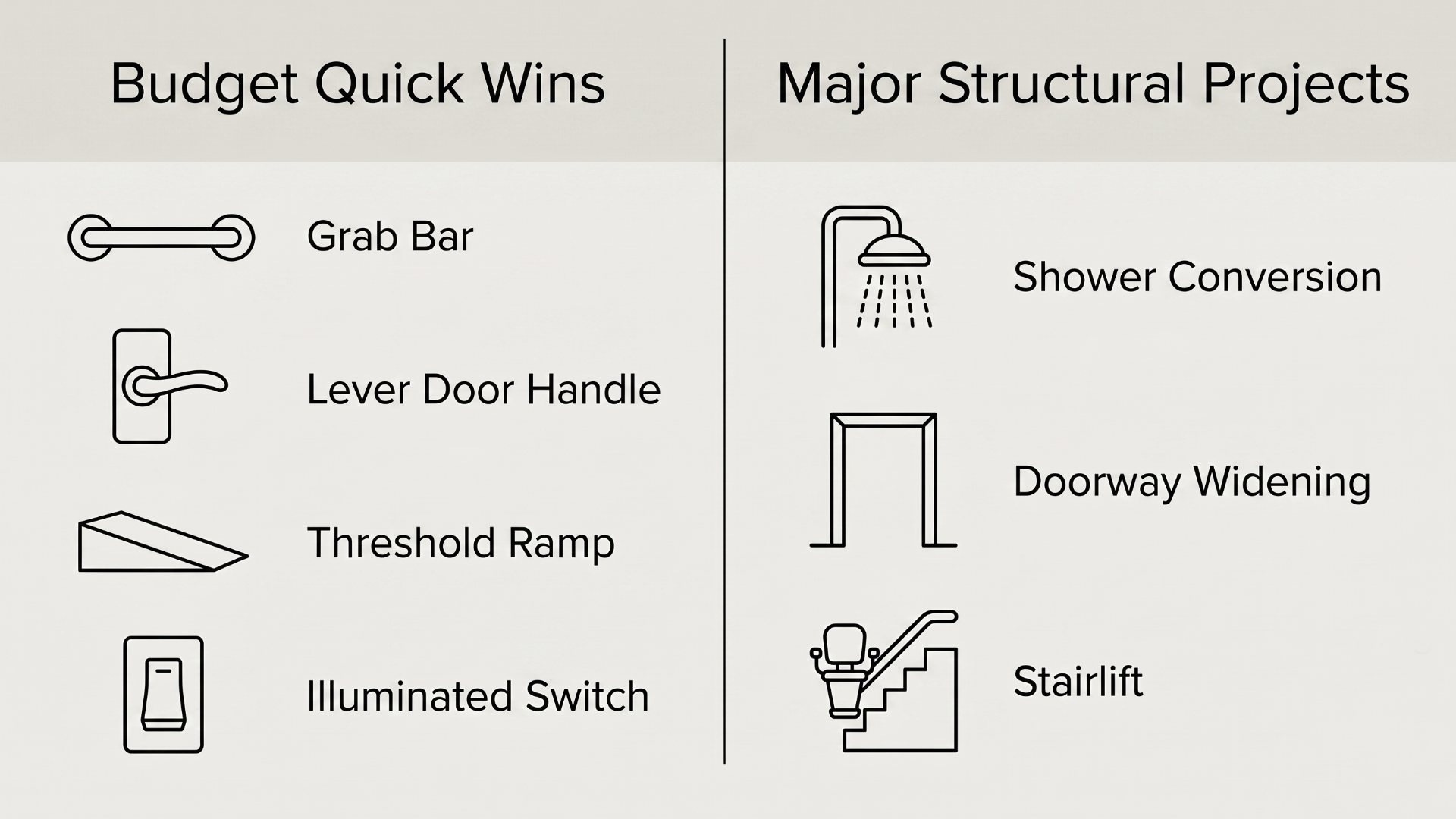
Some retrofits require licensed contractors, permits, and in some cases structural engineering. The most common major projects are: widening doorways or hallways, converting a tub to a roll-in shower, building a permanent exterior ramp, installing a stairlift, and creating a first-floor accessible bedroom or bathroom suite.
These projects are more expensive, more disruptive, and come with hidden costs that rarely surface in initial contractor quotes, MEP utility relocations, subfloor engineering for zero-threshold showers, water heater upgrades for walk-in tubs, and electrical panel capacity for new wet room loads. Understanding those costs before committing to a scope prevents the most common and expensive surprises.
The full breakdown of what major structural modifications actually involve, what they cost in the Chicago suburban market, and what equity impact to expect by price bracket is in the companion guide: Major Structural Modifications for Aging in Place.
The Financial Side, Grants, Tax Deductions, and Illinois Property Tax Relief
Most homeowners do not know that accessibility modifications can be partially or fully deductible as medical expenses under IRS Publication 502. Or that the VA provides up to $126,526 in housing adaptation grants for qualifying veterans in FY 2026. Or that Illinois increased the income threshold for the Senior Citizens Assessment Freeze Exemption to $75,000 for the 2026 assessment year.
For homeowners with significant equity, Illinois Medicaid's 60-month look-back rules also directly affect how retrofit spending is treated if long-term care becomes necessary. Spending on qualifying home improvements is one of the few legal spend-down strategies available, but it has to be structured correctly to survive a state audit.
How Retrofits Affect Your Home's Value
This depends on what you install, how it is executed, and what price bracket you are in.
In the $250,000–$500,000 range, clinical-looking modifications, institutional grab bars, uniformly lowered countertops, walk-in tubs, can reduce marketability with traditional family buyers. The same modifications executed with modern finishes are neutral to positive for buyers in the 55+ segment, which is a growing and active part of the southwest suburbs market.
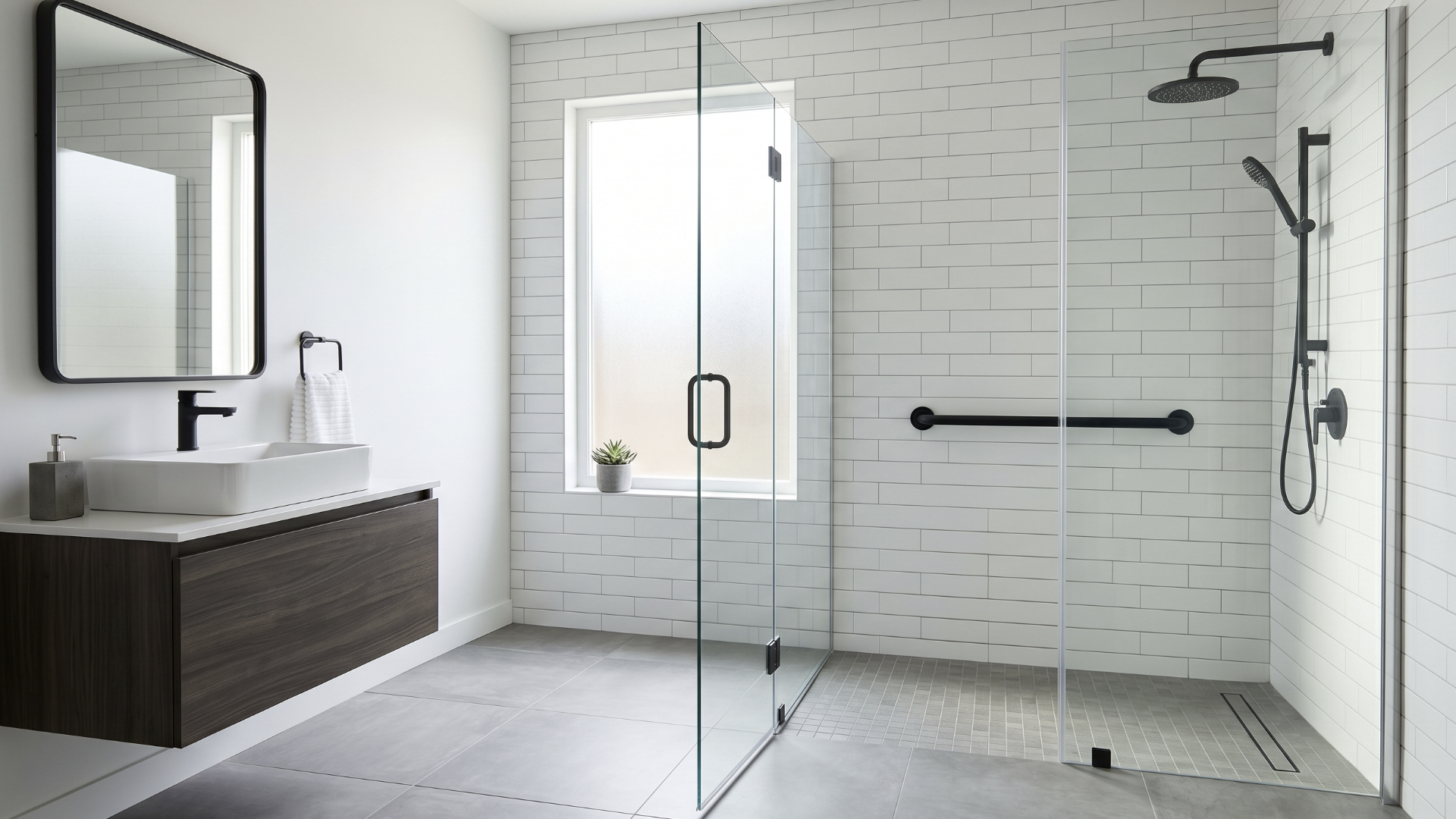
In the $500,000–$1,000,000+ range, zero-threshold showers and thoughtful universal design features are increasingly a market expectation. Luxury buyers want spa-like accessibility, not hospital aesthetics. Matte black grab bars, frameless glass enclosures, integrated seating, and slip-resistant wood-look tile serve both functions. The material choices determine whether the modification adds value or becomes a liability.
If you are retrofitting a home you plan to sell within the next three to seven years, those decisions deserve a real estate conversation before the contractor shows up. The equity implications vary significantly by modification type, execution quality, and neighborhood price point.
Where the Real Estate Side of This Conversation Fits In
Most of this guide is about the home itself. But there is a point in every retrofit conversation where the home and the real estate market intersect, and that is usually where families get caught off guard.
If you are modifying a home you plan to stay in indefinitely, the priority is function, safety, and comfort. If you are modifying a home with an eventual sale in mind, the priority is the same, plus resale impact. And those do not always lead to the same decisions or the same material choices.
I work with homeowners in the southwest Chicago suburbs who are navigating exactly this: planning modifications that improve daily life now without damaging their options later. If it would help to think through the real estate side of your retrofit plan before you start spending money, I am happy to have that conversation.
- Aging-in-place retrofits range from under $100 quick wins to $40,000+ structural projects, knowing where your situation falls determines where to start
- The bathroom is the highest-priority room: stud-anchored grab bars, a raised toilet seat, and non-slip flooring address the most common fall risks first
- Offset swing-clear hinges and rubber threshold ramps resolve most entry and doorway barriers for under $100 before any structural work is considered
- Lighting is one of the most underestimated fall-prevention tools, motion-sensing pathway lighting and illuminated rocker switches are low-cost, high-impact upgrades
- VA grants, IRS Publication 502 medical deductions, and Illinois property tax exemptions can offset significant retrofit costs for qualifying homeowners
- Material choices and execution quality determine whether modifications help or hurt resale value, especially in higher price brackets
Frequently Asked Questions
What home modifications help the most for aging in place?
The highest-impact modifications by room are: bathroom grab bars and a raised toilet seat, non-slip flooring in wet areas, threshold ramps at exterior entries, lever door handles throughout the home, and motion-sensing pathway lighting for nighttime navigation. These address the most common fall and mobility barriers and can be completed for under $1,500 in most homes without structural work. Beyond that baseline, the next tier of modifications, roll-in showers, stairlifts, widened doorways, depends on the specific mobility needs of the occupant.
How much does it cost to retrofit a home for aging in place?
Costs range from under $100 for individual items like threshold ramps and grab bar hardware to $40,000 or more for full structural conversions like roll-in showers or hallway widening. A practical budget for meaningful safety improvements without structural work typically falls between $500 and $2,500. Major structural projects in the Chicago suburban market, doorway widening, wet room conversion, permanent exterior ramps, generally start at $5,000 and scale significantly depending on what the walls and subfloor contain, plus any utility relocations required.
Are home accessibility modifications tax deductible in Illinois?
Certain modifications are deductible as medical expenses under IRS Publication 502 if their primary purpose is medical care for the homeowner, spouse, or dependent. Wheelchair ramps, grab bars, widened doorways, and lowered cabinetry are among the items the IRS presumes do not increase property value, making their full cost potentially deductible on Schedule A subject to the 7.5% AGI threshold. Illinois also offers property tax exemptions for persons with disabilities and a Senior Citizens Assessment Freeze Exemption with an income ceiling of $75,000 for the 2026 assessment year. VA housing adaptation grants are available for qualifying veterans with service-connected disabilities.
What is the first thing to modify in a home for aging in place?
Start with the bathroom. It is statistically the highest-risk room in the house for falls in the 55+ demographic. The first priority is a stud-anchored grab bar near the tub or shower, not a suction-cup version, which fails under real load conditions and carries significant liability. A raised toilet seat and non-slip flooring treatment are the next two additions. These three changes address the most common causes of serious home falls and can be completed for under $500 in most bathrooms without structural modification.
Does retrofitting a home for accessibility hurt its resale value?
It depends on what is installed and how it is done. In the $250,000–$500,000 range, clinical hardware and institutional finishes can reduce appeal to traditional family buyers. In the $500,000–$1,000,000+ range, thoughtfully designed accessibility features, frameless roll-in showers, upscale grab bar finishes, lever hardware throughout, are increasingly expected by luxury buyers and can serve as a differentiator rather than a liability. The determining factor is not the modification itself but the material quality and design integration. In the southwest Chicago suburbs, the growing 55+ buyer segment also means accessible homes have a real and expanding market audience.
Disclaimer: The information provided in this guide is for educational and informational purposes only and does not constitute medical, financial, legal, or real estate advice specific to your situation. Modification costs referenced reflect general market ranges for the Chicago suburban area and will vary based on property condition, contractor selection, and specific project scope. Tax and grant information is provided for general awareness; consult a licensed CPA, tax attorney, or VA benefits counselor for guidance specific to your situation. Raymond Kennedy is a licensed real estate broker in Illinois with eXp Realty.